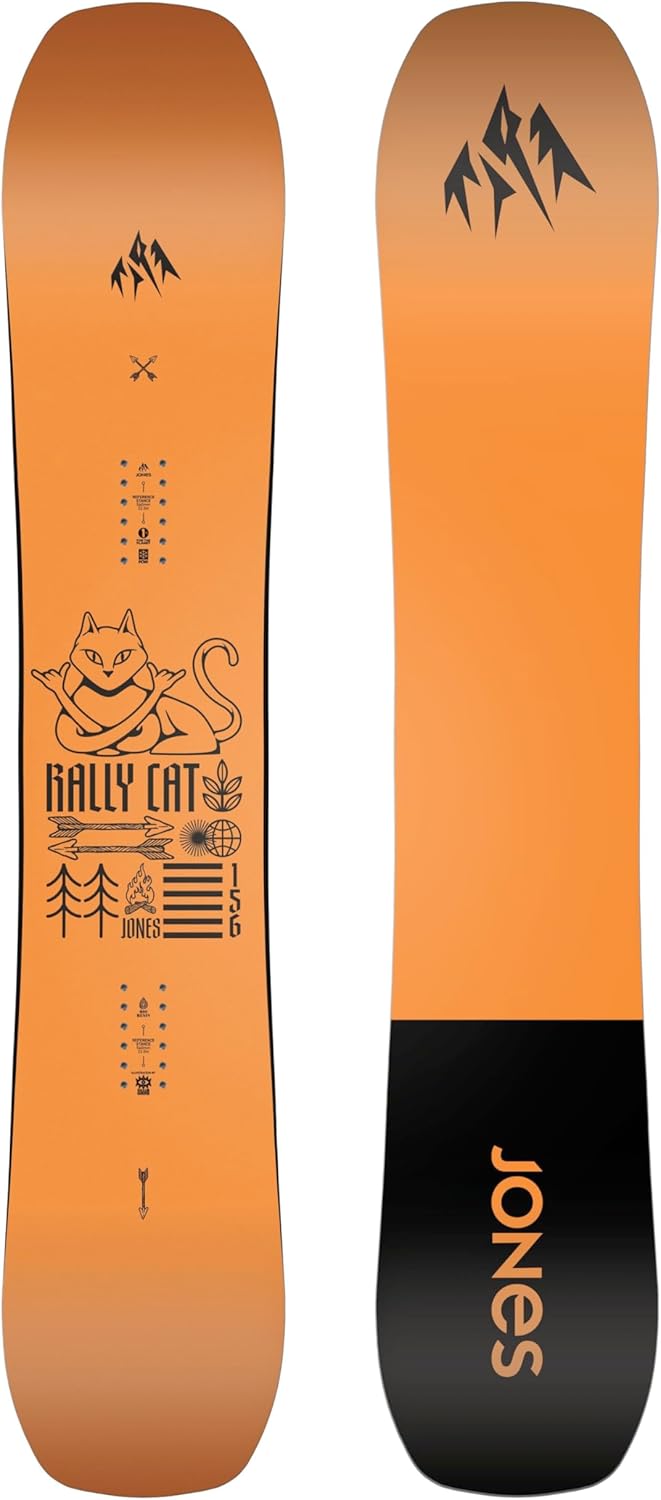
Finding the right board is usually a process of elimination, but sometimes you hit a wall where two options seem so similar that you end up in a state of total analysis paralysis. That was exactly where I found myself when looking at the Jones Rally Cat. Living in a place like Austria, where you have world-class parks right next to massive alpine groomers, you need something that doesn’t just excel in one area but survives in all of them. I’m an intermediate rider, and my days usually consist of a 60/40 split—mostly hitting the park and looking for side hits, but spending enough time on the groomers with friends that I can’t just ride a dedicated jib plank.
The Rally Cat immediately caught my eye, and if I’m being honest, the graphics played a huge part in that. We often try to be technical about our gear choices, but there is something to be said for a board that just looks right under your feet. However, aesthetics aside, the real question was how it stacked up against its sibling, the Tweaker. After spending time diving into the specs and the feel of this board, it became clear that the Rally Cat is essentially the directional twin brother to the Tweaker. It carries over that same playful spirit but adds a bit more utility for those of us who aren't riding switch 100% of the time.
The Shape and Profile
The first thing you notice about the Rally Cat is that it isn’t trying to be a stiff, aggressive charger. It’s built with a friendly flex that feels approachable from the first run. The profile is largely camber-dominant, which gives you that necessary pop for side hits and the stability you want when you're landing in the park. But the secret sauce here is the 3D Contour Base. It’s a low-profile version of Jones’s spooned base technology, and on a board like this, it’s a game changer.
When you're an intermediate rider trying to progress in the park, the biggest fear is always catching an edge on a landing or during a transition. The 3D contouring lifts the edges ever so slightly at the contact points. It doesn’t make the board feel loose or 'washy' on the ice, but it gives you a margin of error that flat boards just don't offer. On the Austrian hardpack, I found that I could still lock into a carve when I wanted to, but the board was incredibly forgiving when I was being a bit lazy with my footwork or coming out of a spin slightly off-axis.
Park Performance vs. All-Mountain Versatility
Because I spend about 60% of my time in the park, I needed to know if the directional nature of the Rally Cat would be a hindrance. It’s marketed as a 'directional tweaker,' and that description is pretty much spot on. While it is slightly directional, the stance and the way the flex is distributed make it feel very natural even when riding switch. I didn't feel like I was fighting the board when coming into a feature fakie.
On the jumps, the board feels light and flickable. At 145lbs with an 8.5 boot, I felt like I had total control over the board's rotation. It isn't a damp, heavy dampener that eats up all the vibration; instead, it's a lively, energetic board that wants to spring off every little bump in the terrain. This is where the 40% all-mountain side of the equation comes in. Those side hits on the side of the groomers are where the Rally Cat shines. It has enough backbone to handle a bit of speed, but it’s soft enough that you can press it and play around without feeling like you’re fighting a piece of plywood.
Real-World Feel and Handling
One thing I was worried about was whether the Rally Cat would feel 'lesser' than the Tweaker, especially since the Tweaker often gets slightly more technical praise in the forums. What I found was that the Rally Cat is simply more honest about what it is. It’s a fun-first board. In powder, the slight directional shape and the 3D base actually provide a bit more float than a true twin would, which is a massive plus when you get those unexpected Austrian dump days. It’s not a dedicated powder board by any means, but it won’t sink like a stone the moment you step off the corduroy.
For someone at my weight and boot size, the width felt perfect. There was no toe drag when leaning into carves on the groomers, yet it didn't feel like a wide boat that was slow to transition from edge to edge. The Rally Cat is nimble. It’s the kind of board that encourages you to try new things because it doesn't punish you for mistakes. If you're an intermediate rider who wants a board that can grow with your park skills while still being a reliable daily driver for the rest of the mountain, this is a very difficult option to overlook. It bridges the gap between a technical freestyle tool and a fun-loving all-mountain cruiser with a level of style that most boards in this category simply lack.