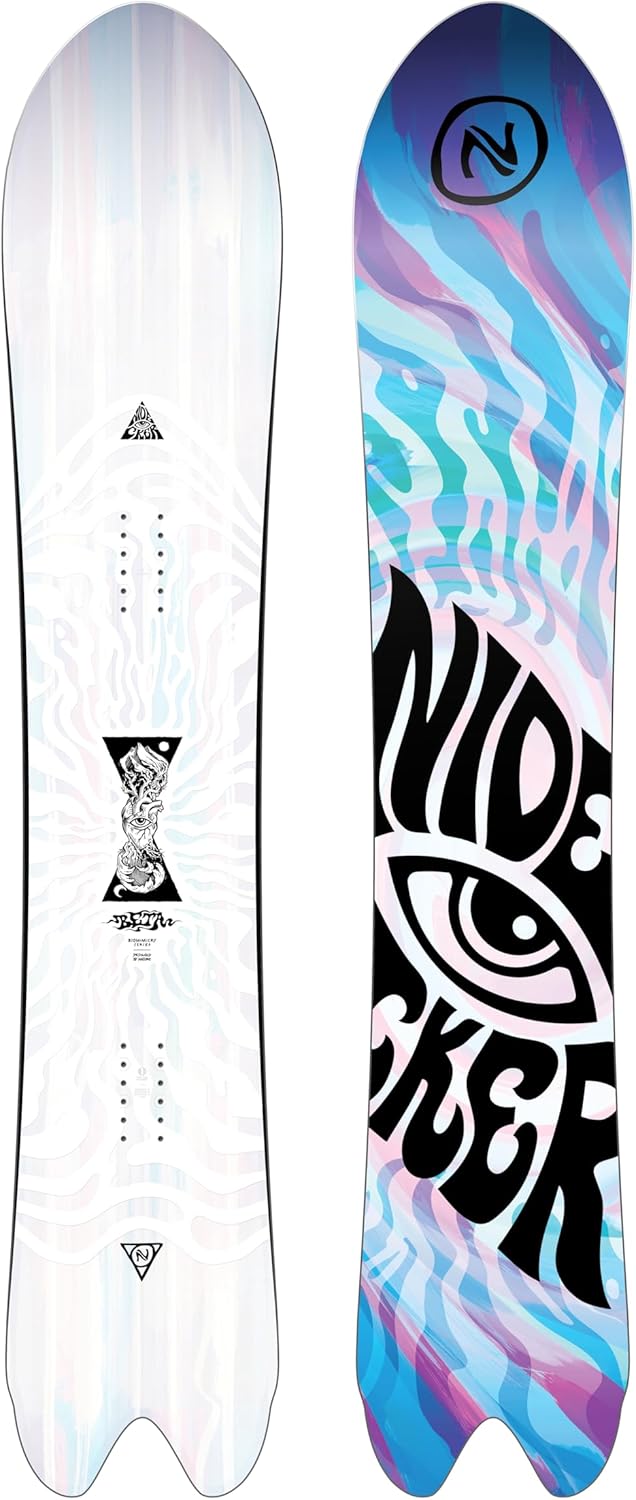
After riding for a long time, you start to develop a very specific sense of what you want from a setup. I spent most of my career on all-mountain boards like the Lib Tech Attack Banana or the Bataleon Goliath. They are great, dependable 'quiver-of-one' decks, but as I’ve gotten older, my priorities have shifted. I’m looking for something that makes the mellow days more interesting—specifically a powder board that doesn't just float but actually feels alive when you're back on the groomers. That led me straight to the Nidecker Beta APX.
What immediately drew me to the Beta APX over something like the Jones Storm Chaser or the Bataleon Surfer is the promise of a more technical ride. When you're looking at powder boards, there is often a trade-off: you get incredible float in the deep stuff, but the board feels like a soggy piece of cardboard the second you hit a tracked-out run or a hardpack groomer. The Beta APX seems to occupy a different space. Based on my research and time looking into the profile, it’s a stiffer, more camber-dominant beast that prioritizes carving competence just as much as it does surfy transitions.
Performance in the Deep and Low-Angle Pow
One of my biggest requirements is float in low-angle powder. We don't always have the luxury of 40-degree steeps, and I need a board that isn't going to sink the moment the terrain flattens out. The Beta APX uses a swallowtail design that naturally sinks the rear, letting that rockered nose stay high without much effort. Even though it isn’t the widest board in its class—coming in narrower than the Storm Chaser—it manages its surface area well.
For a guy my size at 200lbs with a 10.5 boot, width is always a concern. You want that 'volume-shifted' feel where you can size down without your toes dragging in the snow. While the Beta isn't a 'fat' board by modern standards, the shape and the way the taper is handled provide enough lift for those deep days. It feels agile, which is a massive plus when you’re navigating tight trees. I’ve always found that some dedicated powder boards feel like trying to turn a boat, but the Beta APX has a nimbleness that allows you to whip it around obstacles while still maintaining that surfy flow.
Carving and Trail Competence
This is where the Beta APX really starts to pull away from the competition. Most powder-specific decks rely heavily on rocker or huge 3D shaping that can feel loose or 'washy' on edge. Because the Beta is stiffer and features a healthy amount of camber underfoot, it actually bites into the snow. When I’m finishing a tree run and have to burn back to the lift on a groomed trail, I want to be able to lay down a proper carve.
The stiffness of the APX version is a double-edged sword, though. If you're coming from a very soft, playful board, this might feel a bit demanding. But for an experienced rider who likes side hits and medium drops, that extra backbone is a godsend. It provides a stable platform for landings and doesn't buckle when you're charging through afternoon chop. It feels more like a high-performance carving tool that happens to have a powder tail, rather than a powder board that is struggling to stay composed on ice.
Final Thoughts on Versatility
Choosing between this and something like the Bataleon Surfer is tough, especially since I already enjoy the 3BT feel on my Goliath. However, the Surfer can feel a bit massive in tight spots. The Beta APX offers a middle ground that feels more 'normal' underfoot while still giving you that 'fun shape' aesthetic. It’s a board that rewards a rider who still wants to push the limits of their edge-hold even on the deepest days of the year.
If you're looking for the absolute softest, most 'pivot-on-a-dime' surf feel, you might lean toward the Jones. But if you want a board that feels authoritative, carves like a dream, and still handles the deep stuff with ease, the Nidecker Beta APX is hard to beat. It fits perfectly into that gap for the veteran rider who wants a dedicated powder tool that won't let them down when the conditions are less than perfect.