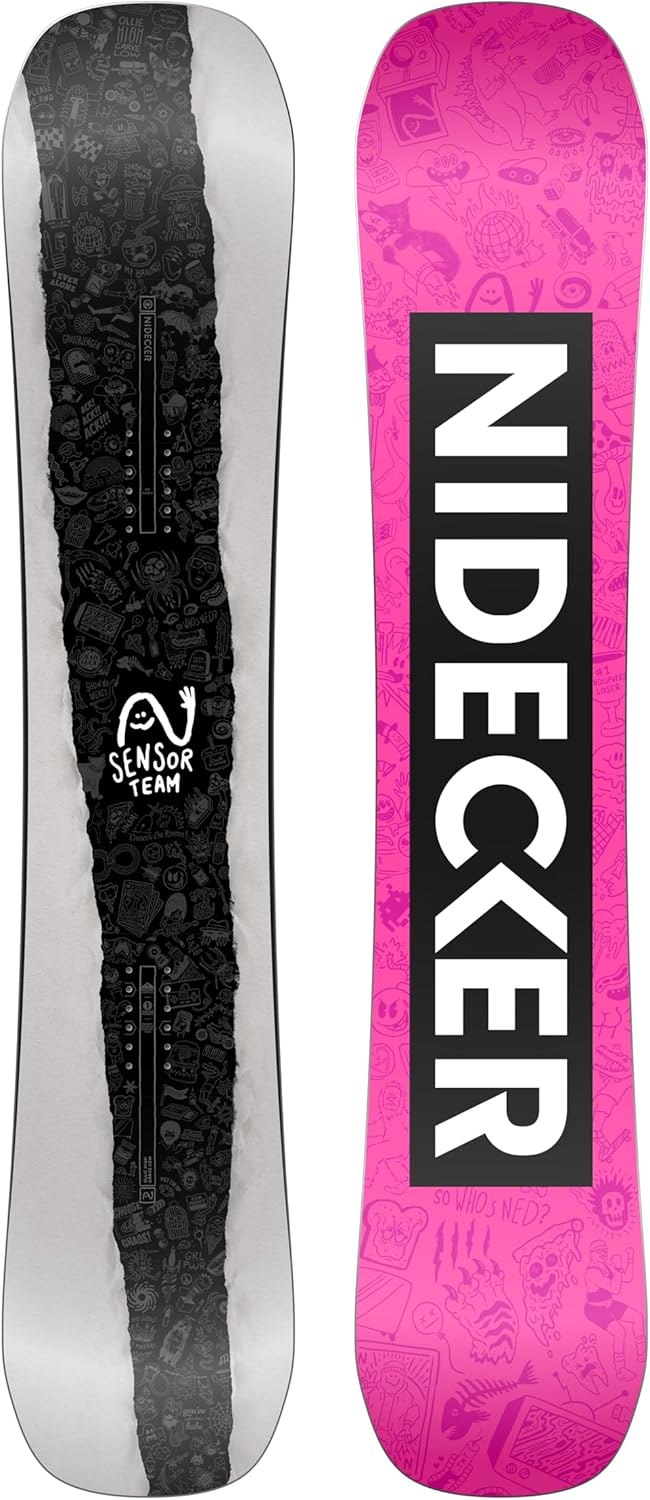
Finding the right balance in a park board is a constant struggle between wanting something soft enough to press and something stiff enough to not wash out on the landing of a twenty-footer. When I picked up the Nidecker Sensor Team, I knew I was getting into something a bit more substantial than your average jib stick. With a flex rating sitting right around a 6.5, this isn't the kind of board you just lazily lean into. It demands a bit of input, but in return, it gives you a level of stability that most dedicated park boards lack.
Usually, when we talk about park boards, we’re looking at flex ratings in the 3 to 5 range. The Sensor Team pushes that envelope toward the stiffer side of medium. This shift is immediately noticeable when you're charging down the run-in to a jump. There’s a distinct lack of chatter underfoot, which is a massive confidence booster when you're trying to dial in new tricks. I’ve spent a lot of time on boards that feel like wet noodles the moment you hit a patch of ice or a slightly uneven transition, but this board holds its line with an authority that feels more like an all-mountain charger than a park specialist.
The Flex and Pop Factor
That 6.5 flex rating is the defining characteristic of this deck. It’s stiff enough that you have to actually work for your presses. If you’re used to boards that fold in half the moment you shift your weight over the nose, the Sensor Team is going to give you a bit of a workout. However, the trade-off is the snap. The rebound on this board is aggressive. When you load up the tail for an ollie, it doesn't just lift; it pops. For someone looking to clear bigger features or get that extra bit of height onto a high rail, that extra tension in the core is exactly what you need. It turns the board into a precision tool rather than just a toy.
Because it’s built for the "Team," the construction feels like it can take a beating. There’s a certain density to the way it rides. It doesn’t feel hollow or fragile. When you're in the park all day, hitting features repeatedly, you want to know that your equipment isn't going to give up on you after a few heavy landings. This board feels like it was designed to withstand the repetitive stress of a full season in the park without losing its structural integrity or that vital cam-out snap.
Binding Synergy and Setup
A major point of contention when setting up a board like this is what to put on top of it. Given the 6.5 flex, you really have to be careful with your binding choice. Pairing this with a super soft, entry-level binding would be a mistake; the board would simply overpower the binding, leading to a laggy response time. On the other hand, going too stiff might make the whole setup feel too rigid for creative freestyle riding.
I’ve been looking at the Union Ultras as a potential match. They have that dampened, surfy feel that could complement the stiffness of the Sensor Team, allowing for some lateral movement when you’re trying to tweak out grabs. Conversely, there’s the Nidecker Supermatic option. While quick-entry bindings are often looked down upon in the park scene, the Supermatics are a different beast. They offer a level of response that actually matches the 6.5 flex of the board. Being able to click in and out quickly between laps is a luxury, but only if the performance is there. On a board this precise, you can't afford to have any play in your interface.
Park Performance and Progression
When it comes to actually dialing in tricks, the Sensor Team behaves predictably. Predictability is arguably the most important trait in a park board. You want to know exactly how much pressure is needed to initiate a spin and exactly how the board will react when you touch down off-bolts. Because it isn't overly soft, it doesn't "hook" unexpectedly on rails, but it still has enough give to let you feel the feature under your feet.
The edge hold is surprisingly decent for a board that spends most of its time on metal and plastic. If you're riding in a region where the morning park laps are on bulletproof ice, you’ll appreciate that the 6.5 flex allows the edges to bite in rather than skittering across the surface. It makes the transition from the groomed run to the park entrance much more fluid.
Ultimately, the Nidecker Sensor Team is a specialist’s board. It’s for the rider who has moved past the beginner stages of freestyle and is looking for a platform that can support higher speeds and larger features. It’s not the easiest board to ride in the world—it requires a certain level of physical input and technical skill to unlock its potential—but for the right rider, it’s a powerhouse. It bridges the gap between a technical jib board and a high-performance freestyle machine, making it a solid choice for anyone looking to push their progression this season.