Salomon Highpath Review: The Stiff One
Every rider who wants a single all-mountain board runs into the same wall. The "safe" picks have a thousand reviews, and the lesser-known alternatives have a handful. The Salomon Highpath sits in that second group, and it deserves more attention than it gets. The question: is it the stiff charger some riders say, or the approachable cruiser others claim?
What It Is
The Highpath is a directional twin built for all-mountain and freeride use. It is directional, but it feels less stuck in one direction than a heavily tapered freeride board. Switch riding does not come with a dragging-tail feeling, so you can spend part of your day riding switch or landing 180s off natural side hits without it feeling like a handicap.
It also has a width that gives a stable platform for larger boots without feeling sluggish.
The Flex Mystery
If you research this board, you will hit a contradiction. Some call it a stiff charger. Others say it is surprisingly soft. Both have a point, and the board's feel is hard to pin to a single number. Salomon rates it stiff. Retailers rate it somewhere in the stiffer part of the range. Owners and demo riders agree on the main point: it is stiffer than most boards in its class, including Salomon's own Assassin.
On groomers at speed it feels stable and damp, which points to a stiffer core. In bumps and at lower speeds there is some torsional play that makes it more approachable than a true plank. That mix suits a one-board quiver: stiff enough to hold an edge when things get icy, soft enough to stay comfortable by mid-afternoon when your legs start to give out.
On Snow: Calm at Speed
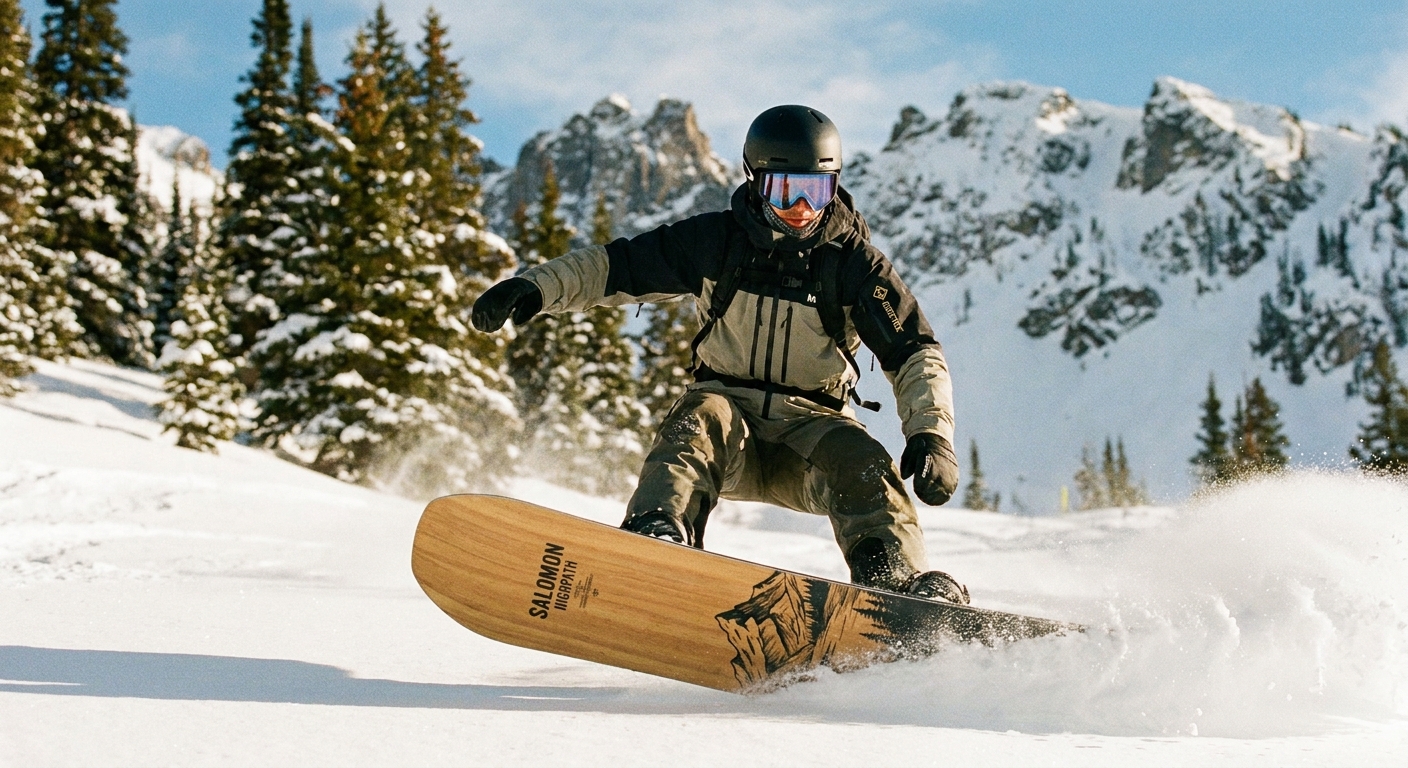
The Highpath carves well. Owners call it stable at speed and comfortable at any pace, and one rider with roughly a week of days on it said it simply rips. In cruddy snow, which is where a stiff board earns its keep, it stays composed. On groomers it holds an edge and feels fast. It is also good for the occasional powder day at the resort.
It is a board that asks for input and rewards it with speed. If you are coming off a softer mid-flex all-mountain deck, the extra stiffness will feel like a step up and a real change in feel.
Where It Falls Short
Playfulness. The stiffness has a price. Riders who demoed it next to the Assassin say the Highpath was noticeably stiffer and lost a lot of the playfulness. The Assassin felt freer on side hits and in the trees, while the Highpath felt more serious. If you ride at an easy pace with slower friends, the softer board may suit better.
Park. It is a poor pick if you spend time in the park. A softer board makes more sense there.
A soft-board transition. Riders who are moving from a very soft board may find it demanding at first.
Durability
Owners report few problems. One rider with two Highpaths, a 159 and a 159W, said both were awesome, but had a top sheet crack with a line running across it and replaced the board under warranty. Most reports describe a solid, well-built board, and the occasional cosmetic flaw is something warranty covers.
The Debate: Highpath or Assassin?
This is the comparison riders keep making. The Assassin is the freer, more playful pick, a freestyle all-mountain board that is comfy in the trees, decent enough in a carve and fun on side hits. The Highpath is the stiffer pick for riders who want edge hold, stability and speed.
One demo rider who rode both back to back put it plainly: the Assassin was the favorite for easy, playful days, while the Highpath felt faster and likely better at carving with more time. Another owner said that if you do not ride park and are choosing between the two, the Assassin is not the stiffer choice. The decision comes down to how you ride. Charge hard and want to improve your carving? Highpath. Ride relaxed and play on the way down? Assassin.
Who Should Buy It
Intermediate to advanced riders who want to improve their carving and ride fast on resort terrain. It is a good fit for those who want a single stable deck for groomers, bowls and the occasional soft day, and for riders who value value-for-money over brand prestige.
Who Should Look Elsewhere
Park riders, riders who want a soft, forgiving feel and riders who prefer to cruise should look at the Assassin or another mid-flex board. Beginners will find it a lot.
Alternatives
The Burton Deep Thinker is the proven community favorite, though heavily directional, so it can feel limiting if you ride switch often. The Salomon Assassin is the softer, more playful sibling. The Rome Warden is a mid-flex workhorse that sits a step below the Highpath.
Pro tip: If you are between the Highpath and Assassin, think about your usual riding partners. Stiff boards reward speed, and speed is more fun when the group can keep up.
Verdict
The Salomon Highpath is a stable, fast carving board at a fair price. It leans stiff and gives up some play. For riders who want edge hold and speed on resort terrain, it works, and it is a legitimate challenger to the safer, better-known names.