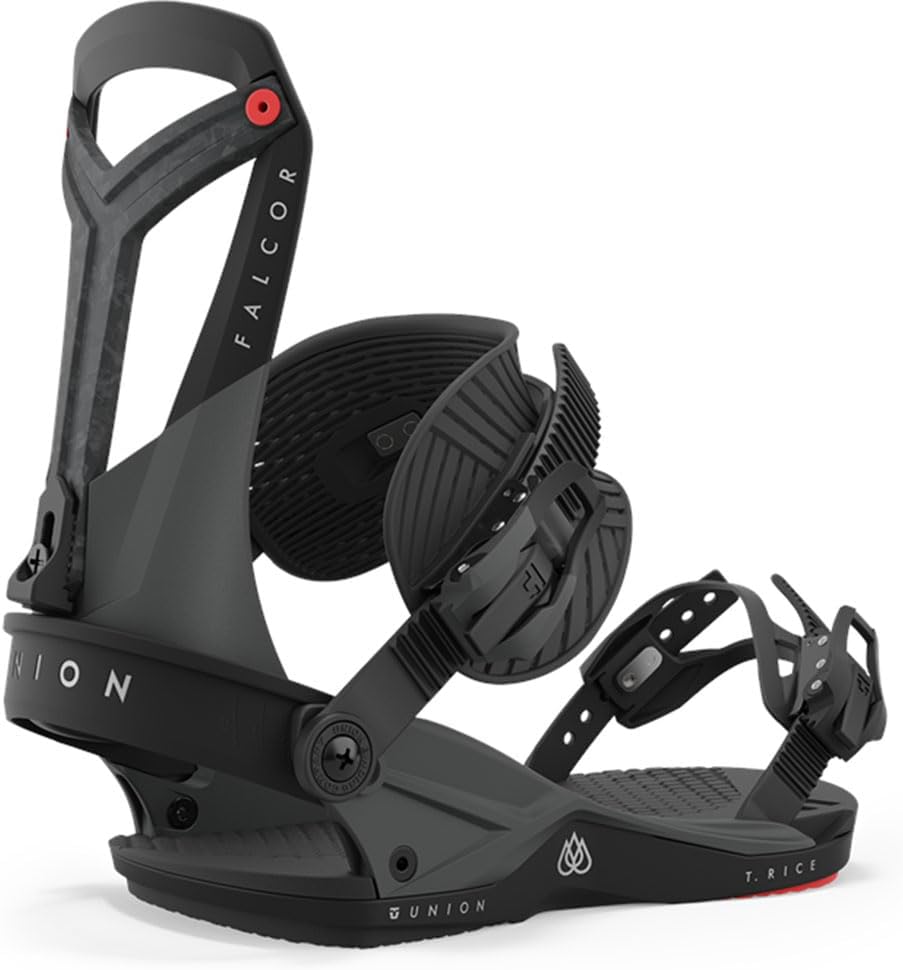
The Union Falcor is a binding that's hard to put in a box. Union markets it as a freestyle binding. Riders who spend their days carving groomers and threading trees use it too, and they have good reasons. It has a mini disc, a carbon highback and a stiff feel. The question this review answers is a common one: can a binding be good at carving and good in the trees, and how does the Falcor compare to its stiffer sibling, the Union Atlas?
What It Is
Two design choices define the Falcor. The first is the mini disc. Instead of a large disc that puts a lot of hard plastic between the board and your boots, the Falcor uses a small one. It mounts on 2x4 and Channel boards, but not 4x4. That matters if you ride an older board, so check your inserts before you buy.
The second is the carbon highback. It responds quickly when you lean into a heelside turn, but it's designed to allow some rotational flex. That's what gives the Falcor its looser feel compared with a binding with a uniformly stiff highback.
The overall flex is stiff. Owners put the Falcor close to the Atlas for response, though not quite there.
On Snow: Quick Edges, Loose Hips
For carving, the Falcor is genuinely quick. The carbon highback drives the heelside turn hard, so edge-to-edge response feels crisp. Stiff bindings reward that kind of riding. There's no mush between your calf and the board.
The mini disc changes the feel in a way you notice. Nearly all the contact between binding and board comes through a bushing instead of hard plastic. That adds a slight pause as you load the heel or toe edge, because the bushing has to compress. Owners report that the bushing is stiff and the delay is small. It's a trade you'll feel on the first day and forget by the third.
What you get in return is a board that flexes more naturally underfoot. The rotational give in the highback lets you load the board and aim it through a line. In trees, that feels more like a dance than a charge.
The Trees Debate
Ask riders what a tree binding should be and you'll hear two camps. One wants the stiffest binding possible, for the quickest edge-to-edge. The other prefers a surfier binding, so they can almost pre-load the board for a line through the trunks. The Falcor lands in the second camp's territory while keeping most of the first camp's response.
Snow conditions matter too. In tracked-out, mogul-filled trees, some riders say a medium or slightly softer flex helps the board bend through bumps. Stiff bindings reward clean footwork and punish lazy technique, especially at the end of a long day. If you know you'll ride sloppily when tired, factor that in.
Falcor or Atlas?
This is the question most buyers face. The Atlas has a full-size disc and a larger baseplate. It feels more instantly responsive, with more direct contact between hard parts and the board. Its highback is more uniformly stiff. That adds up to a locked-in freeride character.
The Falcor feels more playful. It's a better fit for riders who like side hits, rollers and tree lines, and who want some surf in the ride. If you chase maximum response on hard snow, the Atlas is the answer. If you want a stiff binding that doesn't feel like a cast, the Falcor makes more sense.
Owners who have both put it simply: the Atlas is a hard charger first, and the Falcor is a playful hard charger. The Atlas feels more locked in. The Falcor feels surfier, and owners single out the comfort. Several call it the most comfortable binding they have owned, and the heel strap is easy to forget once you are strapped in. The carbon highback explains a lot of the feel. It is very rigid in the forward direction and relaxed side to side.
Not everyone agrees on stiffness. One rider with eight days on them calls the Falcor a park binding with freeride response, and the fastest edge-to-edge of any binding they have ridden. A 25-year rider who likes stiff gear found it soft next to the Atlas and went back to the Atlas. Where you land depends on what you ride now.
Pro tip: If your board has 4x4 inserts, you don't have a choice. The mini disc won't fit, and the Atlas is the Union to buy.
Falcor or Rome Katana?
Riders shopping a stiff freestyle binding also cross-shop the Rome Katana, usually in its FASE fast-entry version. Owners who have ridden both say they are close in performance. Falcor owners point to the build quality and a better ankle strap. Katana owners like the adjustable ankle strap, which lets you set it for more tweak or more drive, and the fast entry.
For a rider still learning freestyle, one owner who has both found the Falcor noticeably stiffer and less forgiving. If you are learning side hits and butters, the Katana is the friendlier pick. If you already ride clean and want the comfort, go Falcor.
Where It Falls Short
- The pause. The bushing adds a small delay loading edges. It's minor, but riders used to full-disc bindings notice it.
- Not the most reactive. The Atlas is more instantly responsive.
- Board compatibility. No 4x4 mounting.
- Demanding. A stiff ride asks for clean technique, and it's less forgiving when you tire out.
- Durability reports. One owner says earlier models kept breaking, and blamed short screws. Check the hardware early in the season.
- Mini disc limits. Owners note that a mini disc cannot use some boards' extra powder or slam-back inserts.
Who Should Buy It, Who Should Look Elsewhere
The Falcor suits intermediate to advanced riders who want a stiff upgrade from an all-mountain binding. It works for freeride, carving and tree runs, and it handles side hits better than most stiff bindings. If you've outgrown a soft starter binding and your riding is moving toward speed and technical terrain, this is a natural step up.
Look elsewhere if you want a very loose park binding, since the stiff flex will feel like work. Look elsewhere too if you want the most direct, locked-in response possible, or if your board has 4x4 inserts.
Alternatives
The Union Atlas has a full disc and a more locked-in, instant response. Pick it if you mostly charge on hard snow. Read our full Union Atlas review.
The Rome Katana FASE is close in performance, with fast entry and an adjustable ankle strap. Pick it if you are still learning freestyle. Read our full Rome Katana review.
The Union Strata is softer and more forgiving. Pick it if you want a playful binding for side hits and park. Read our full Union Strata review.
Verdict
The Union Falcor is a stiff, capable binding with more play than it looks. It carves well, feels surfy in the trees and fits a wide range of boards. It gives up a little instant response to the Atlas. For riders who want that balance, it makes a lot of sense.