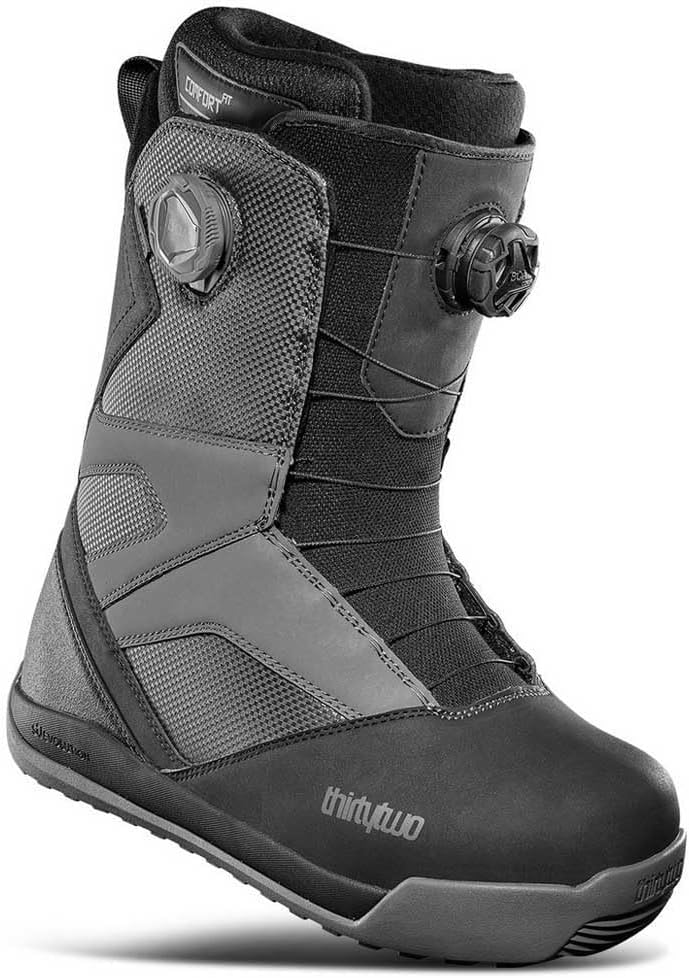
Not every boot needs to be a mountain-slayer. Plenty of riders spend their days on small hills, lap family-friendly runs, ride indoors or just want to be comfortable for six hours without thinking about their feet. The ThirtyTwo STW Double BOA is built for that crowd. The question this review answers is whether a soft, dual-BOA boot holds up, and where it stops being enough.
What the STW Double BOA Is
The STW is a soft-flexing, comfort-first boot with a dual BOA closure. One dial handles the lower portion of the boot and the other handles the upper, so you can set the forefoot relaxed and the ankle snug instead of compromising with one cable. That is the real selling point. Compared with a single-dial boot, where cranking the cuff often crushes the toes, a two-zone setup lets you balance support against circulation.
It is a light boot, nothing like the heavy, lace-up bricks from a couple of decades ago. The lining is fleece and the shell is a soft synthetic. Owners on forums often ask what "STW" stands for; it does not matter much, and riders note the name does not mean the boot is built for wide feet. Treat it as a normal-width boot and try it on.
On Snow: Soft and Easy
The flex is the defining trait. It is soft, and ThirtyTwo built it to be. For slow laps, learning turns, buttering around the mountain and spending time in the trees, that is exactly what you want. A soft boot means less fatigue, easier walking and more forgiveness when you land a little off balance.
The trade-off shows up at speed. Push hard on a high-speed carve or hit larger jumps and the boot can feel mushy, because there is not enough backbone to transfer your energy into the board. Owners who started on it say the same thing: they are happy with it, but the next boot they buy will be a step stiffer.
On icy hardpack, it still gives enough lateral support to manage the board, because modern sidecuts and bindings do much of the work of getting you on edge. You do not need a rigid shell to hold an edge on a groomer at moderate speed. You do need to be realistic about how fast you are going.
Comfort and Fit
Out of the box, the STW is comfortable. There is little or no break-in, and most riders report that the liner settles within a few days of riding, whether or not you heat-mold it. For a boot in this price range, that is the whole point.
The dual BOA system adds convenience. Pop the dials, slide your foot out for lunch and tighten again in seconds. Anyone who has fought frozen laces with cold fingers will notice how nice this is.
Owners report STWs lasting over 80 days on East Coast hardpack and ice, never letting water in and staying comfortable all day. That is a strong durability report for a soft, budget-leaning boot. Treat it as a good sign rather than a guarantee, but it matches the general view that the STW holds up when used as intended.
The Debate: Is It Good Enough?
When riders ask whether a mid-priced ThirtyTwo is "good", the real question is how much boot they need. The STW is not a bad boot, it is a specific one.
You will see the Lashed Double BOA mentioned in the same breath. The Lashed is a step up in stiffness and price, and some owners prefer it for harder riding. The trade is that a stiffer boot can take longer to feel good. If your riding is gentle and your priority is comfort, the STW gets you most of the way there for less money.
The worry about BOA reliability comes up too. Some riders have had cables fail on older or cheaper systems and prefer laces. In general, the technology has matured, and the dual-zone setup is easy to maintain. If you ride somewhere remote, carry a spare cable and cord.
Who Should Buy It, and Who Should Look Elsewhere
Buy the STW Double BOA if you ride at a casual pace, spend time on small or indoor mountains, are returning to the sport or learning, and care about comfort and easy entry. It also suits anyone who wants a forgiving boot and spends more time cruising than carving.
Look elsewhere if you carve hard, ride big terrain or hit large features. A stiffer boot will give you the support that a soft one cannot. If the first pair you try is too tight or loose, listen to your feet; owners agree that fit is the most important factor in this category.
Pro tip: Try the boot on in a shop with your own socks. A BOA boot works best when the liner and shell sit properly, and a quick heel lift test will tell you more than any review.
Alternatives
- ThirtyTwo Lashed Double BOA: Stiffer and pricier, a better choice if you want more support.
- K2 Maysis: A popular comfort-oriented option that owners mention for similar riders.
Verdict
The ThirtyTwo STW Double BOA does what a soft comfort boot should do. It is easy to get on, comfortable from day one and forgiving on small mountains. It is not a boot for fast, aggressive riding, and riders who push their limits will outgrow it. For casual days, it is an easy recommendation.