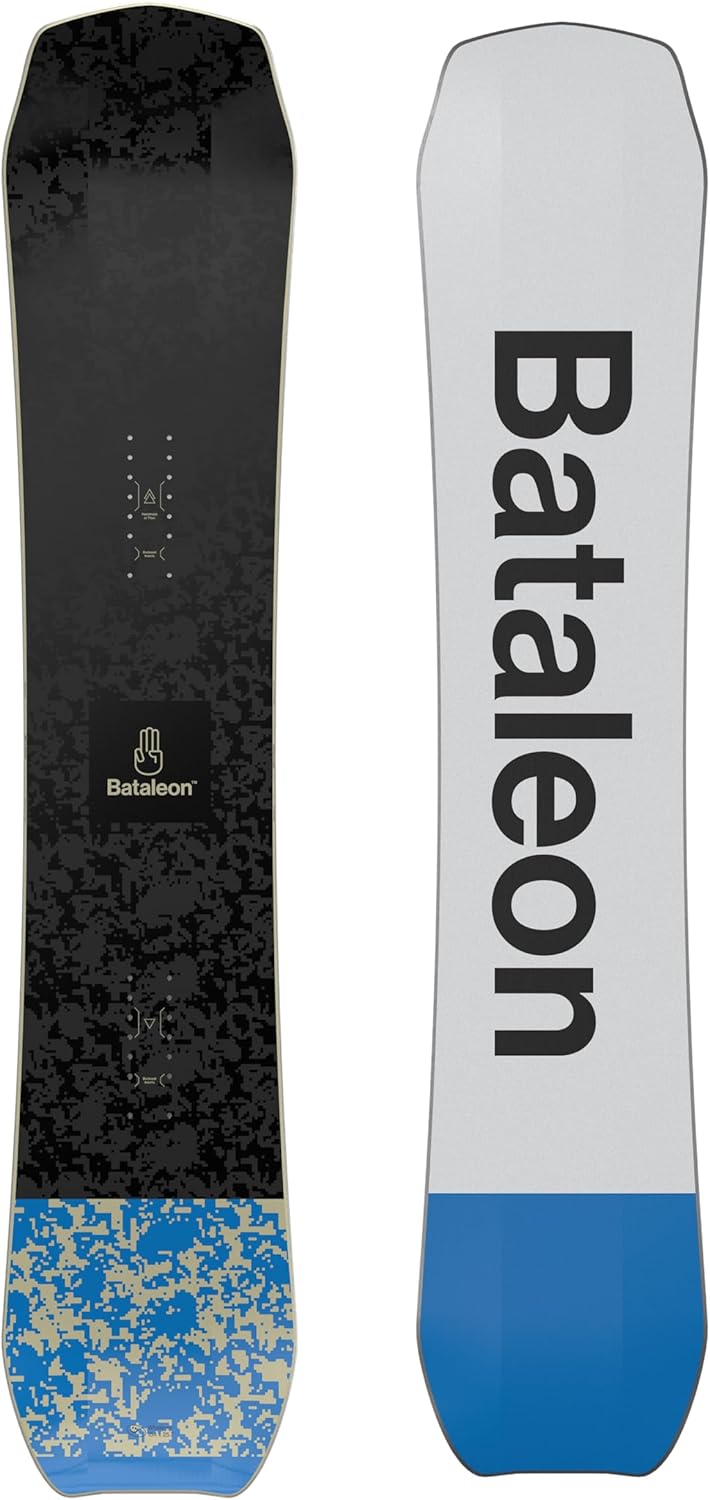
The Bataleon Whatever has a reputation as a soft, friendly, catch-free board. The Beyond Medals collab is the version for riders who found the standard model too mellow. It keeps the same shape and Triple Base Technology (3BT), but owners and early buyers describe it as beefier and closer to the Goliath in tech and feel. The question this review answers: is it a one-board quiver for riders who want freestyle fun without giving up speed?
What You're Actually Riding
The Whatever outline looks directional, with a slightly longer nose, but the contact surface is twin. That is the trick of the shape. You get float and a planing nose in soft snow, and you can still ride switch and throw it around like a skate deck. Bataleon lists the standard Whatever as a medium camber board with a directional twin all-mountain shape, 3BT with Sidekick, and a 5/10 flex. The collab is reported to be stiffer than that, though Bataleon does not publish a separate number I can point to.

3BT is the real talking point. Instead of serrated edges like Magne-Traction, the base is split into a center and two side bases, and the side bases lift up toward the nose and tail. The idea is simple: nothing grabs when you land a little off-center or slide onto a side hit. It also helps the board float, since the lifted sections do not dive in deep snow.
Another detail owners like: the insert pattern allows a set-back stance. If you want to go full directional for a powder day, you can kick the bindings back and let the nose do the work.
How It Rides
Owners agree on the first impression: it takes a few runs. The 3BT feel is different from a traditional camber or hybrid board, and the edge-to-edge sensation is looser and more surfy. Once it clicks, riders describe it as a blast. Carving is described as effortless, and side hits, rollers and butters are where it feels most at home.
In soft snow and trees, the lifted sidebases and relaxed edges make the board forgiving. It floats over pow, pivots easily between trees, and does not catch an edge when you get sloppy. Owners who ride a wide version as a dedicated deep-snow tool call it beefy and damp, plowing through chop while still turning easily in soft stuff.
On groomers, it is capable but not a hard carver. Edge hold is the trade-off of 3BT. Several riders say they do not love the feel on firm snow, and one reported that it is not their pick for groomers at all. If your day is mostly hardpack and ice, a board with serrated edges or a classic camber holds better.
In the park, it is playful, but this is not a dedicated park board. Owners describe it as a freeride board with freestyle manners: butters, small kickers, the odd box, but not a rail-laps tool.
Where It Excels
The best case for the Whatever is the hybrid rider who spends days hunting side hits, shaping lines through trees and charging back bowls. It forgives mistakes, floats better than most twins, and has enough stiffness in the collab version to feel stable at moderate speed.
It is also a good fit for riders stepping down from a very aggressive board who want to loosen up. The catch-free feel makes it easy to get playful on terrain that usually feels serious.
The graphics are loud and good looking, which does not matter for performance but is part of why people buy it.
Where It Falls Short
Edge hold on ice is the main compromise. 3BT trades grip for forgiveness. You can ride it fast, but past a certain speed on firm snow it will feel less locked in than a stiff camber board.
Quality control gets mentioned. One buyer reported delamination near the edge after a single ride and filed a warranty claim. One report is not a pattern, but it is a reason to inspect a new board carefully and keep your receipt.
The learning curve is real. If you are used to a locked-in camber ride, expect a few runs of recalibration. Riders who give up in the first hour tend to miss what the board does well.
Availability is a hassle. The collab is a limited run. The standard Whatever is much softer, so do not assume they ride alike.
The Debate: Is It Stiff Enough?
You'll find riders asking whether the collab is stiff enough for aggressive riding, or whether it is just a graphic swap. Owner reports say it is a real change: more beef, more stability, more damp feel than the standard. It is less forgiving than a very soft park board like a DOA, with more stability but less play. But no one calls it a stiff freeride plank. Think of it as the middle of the road, with the 3BT shape doing the work that stiffness does on other boards.
Pro tip: Size up and consider a wide if you are between sizes. Owners say 3BT boards tolerate a larger size well because the lifted sidebases keep the board from feeling long or hooky.
Who Should Buy It
Buy it if you ride the whole mountain like a playground: trees, back bowls, side hits and the occasional kicker. Buy it if you want a surfy, forgiving feel and a stance that can go set-back on deep days. It also suits riders who want one board for most days, as long as most of those days are not boilerplate ice.
Look elsewhere if you carve hard on firm groomers all week, ride at high speeds on hardpack, or want a dedicated park board. A directional camber board such as a Lib Tech Orca-style freerider or a classic twin like the DOA covers those jobs better.
Alternatives
The Bataleon Goliath is the stiffer sibling and the board the collab is often compared to. The Bataleon Evil Twin is a more freestyle-focused option. A Lib Tech Skate Banana or Jones Mind Expander will give you a different take on the playful all-mountain board with a more traditional edge feel. Read our full Lib Tech Skate Banana review.
Verdict
The Whatever x Beyond Medals is a fun, forgiving, surfy board with more backbone than the standard Whatever. It floats, it turns easily in trees, and it rewards riders willing to adapt to 3BT. It will not win on ice. If that trade-off suits your terrain, it is a genuinely good one-board option.
Rating: 7.8/10