The Original Organic
Most surf wax smells like a candy store and is made from petroleum. Matunas goes the other way. It has been making natural, petroleum-free wax in Santa Cruz, California, since 1998, and it is the best-known organic wax brand. The question every eco-minded surfer asks is whether a clean bar grips as well as the paraffin standbys.
This review covers the Cool, Warm, Tropical and Basecoat bars I surfed, plus the Cold bar. Each one has its temperature range, feel and rating below.
Quick pick:
- Cold water: Cold (blue)
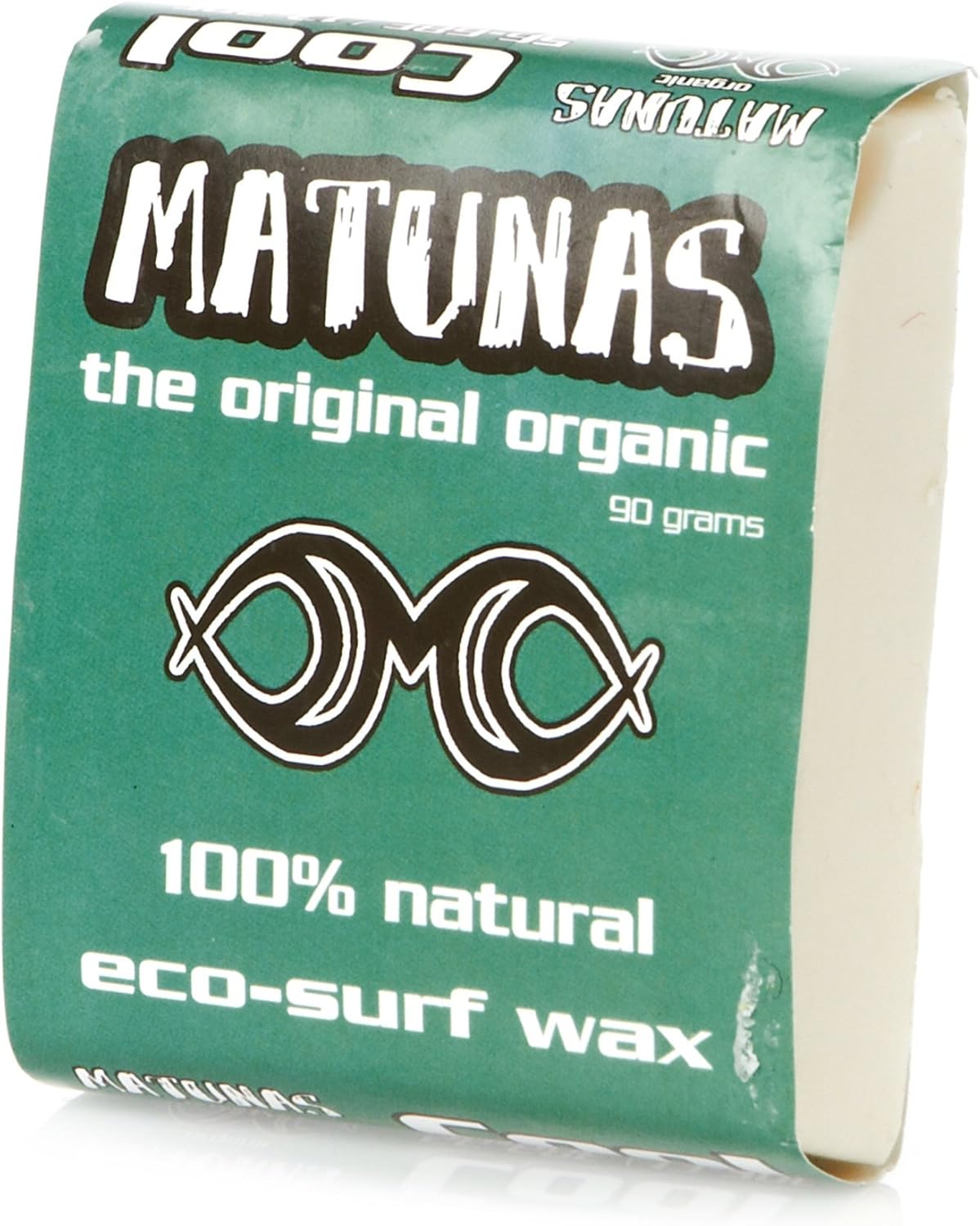
- Spring and fall water: Cool (green)
- Summer water: Warm (red)
- Hot water: Tropical (yellow)
- A natural foundation under any of them: Basecoat
How the Matunas Range Works
Every bar weighs 90 grams, comes in a recycled paper wrapper and is rated by water temperature, softest to hardest:
- Cold: 60 F (15 C) and below
- Cool: 56 to 68 F (14 to 19 C)
- Warm: 64 to 74 F (18 to 24 C)
- Tropical: 75 F (24 C) and up
- Basecoat: under any top coat
Matunas sells the wax as organic, biodegradable and non-toxic, and says the scent comes from real strawberries, raspberries and jasmine flowers. Those are the brand's claims, not lab results. What you can judge is the bar: denser and drier than paraffin, with a mild, clean smell instead of a coconut cloud.
Cool (Green)
- Water temperature: 56 to 68 F (14 to 19 C)
- Hardness: Medium soft
- Scent: Mild and natural
- Rating: 7/10
- Check the price on Amazon
Cool water is where most surfers spend a big part of the year, so this is the bar that matters. It takes a little more pressure to start the bumps than paraffin, and a warm board makes it worse. Cool the deck, work in cross-hatch lines and give it a minute. The texture comes out as flat, sticky coverage rather than neat round beads. Stop when the surface feels grippy, not when it looks like a classic wax job.
In its range it gives a firm, tacky surface that holds through a normal session. The grip feels like high-friction rubber rather than glue. It is strongest in the first hour, then settles into a steady hold. Push the water warmer and it softens fast; push it colder and it loses some stick.
Warm (Red)
- Water temperature: 64 to 74 F (18 to 24 C)
- Hardness: Medium firm
- Scent: Mild and natural
- Rating: 7.2/10
- Check the price on Amazon
Warm is the grade many surfers use most. It is denser than paraffin and harder to start, and a deck hot from the car is its enemy. Let the board cool in the shade, wipe it clean and rub in cross-hatch lines. In the middle of its range it stays tacky without smearing, and it responds to foot shifts without feeling glued on.
Sun tolerance is a highlight. A paraffin warm bar can turn to a slick puddle after a few minutes in direct sun, while owners say this blend holds up better on the walk down to the beach. Owners also report little wax rubbing onto a wetsuit. Some rank Matunas Warm with Bubble Gum Warm as the best bars for their local water.
Tropical (Yellow)
- Water temperature: 75 F (24 C) and up
- Hardness: Hardest top coat in the range
- Scent: Mild and natural
- Rating: 7.3/10
- Check the price on Amazon
I worried it would smear into a flat, slippery layer, as some organic waxes do. It does not. It forms smaller, more refined bumps than the sharp peaks of a high-tack synthetic, and the first coat goes on far better over a basecoat. In water near 78 F, where many waxes go mushy, it stayed firm. The grip is consistent and predictable rather than glued down.
It does not have the staying power of a heavy-duty paraffin bar over several days. I wanted to comb it up every couple of sessions, and it wore a little faster under the chest after a long morning.
Pro tip: Carry a comb. A quick scratch brings the bite back between sessions.
Basecoat
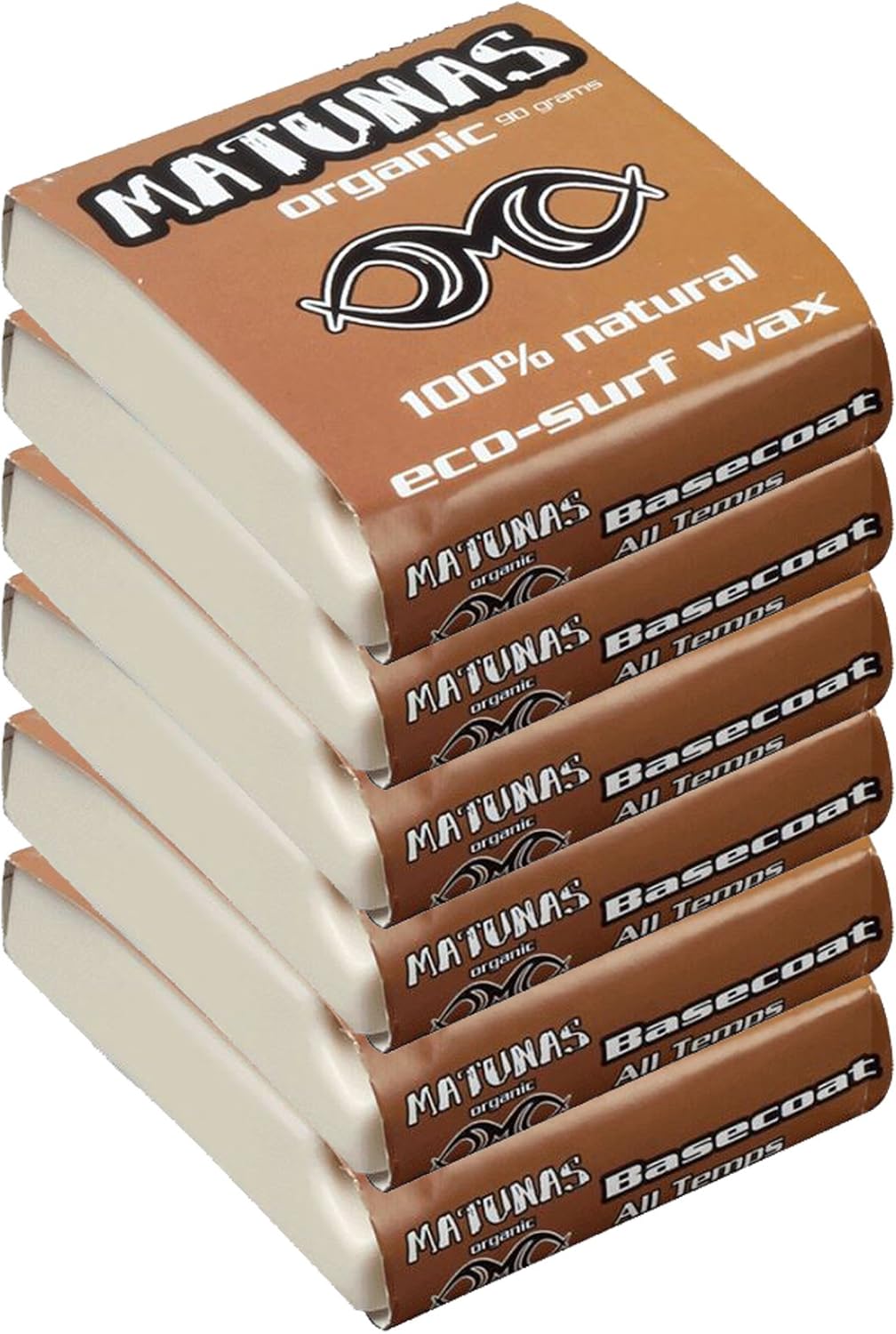
- Water temperature: All temperatures, under a top coat
- Hardness: Hard
- Scent: Mild and natural
- Rating: 6.9/10
- Check the price on Amazon
The basecoat is the layer that matters most if you want a board free of petroleum wax. The bar is firm and dense, closer to clay than to a greasy wax block, and the first beads take real pressure. Start on a cool, clean deck and work in cross-hatch lines. The bumps come out flatter and wider than synthetic beads. That is fine for grip, but it looks different.
Under a top coat it stays put and does not turn gummy. It is often sold in six-bar packs online, since few shops stock it.
Cold (Blue)
- Water temperature: 60 F (15 C) and below
- Hardness: Softest in the range
- Scent: Mild and natural
- Rating: Not rated
- Check the price on Amazon
Cold is the soft bar for winter water and thick suits. I have not surfed it, so it has no rating here. Expect the same dense, natural feel as the Cool bar, tuned to stay tacky on a chilled deck.
Does Organic Wax Work?
Surfers disagree sharply. Some tried natural brands, found them too sticky, too mushy or inconsistent, and went back to paraffin. Others have used Matunas for years and call it their favorite. Cost and availability, not performance, are the usual reasons people do not switch.
My read: it is a real wax that works, with a different feel and a short adjustment period. Most of us never notice a small gap in stick, because technique and board choice matter far more than the last ten percent of tack. For competition, where every bit of stick counts on an air, a high-performance synthetic is the safer choice.
Waxing and Care
If you are switching from paraffin, strip the board fully first. Natural wax layered over old, dirty paraffin turns into a slippery slurry. Start with the Matunas Basecoat on a cool, clean deck, then add the top coat that matches your water.
Plan to top up every other session, and comb the bumps between surfs. Cleanup is the quiet win: a natural coat comes off cleaner, with less oily residue, and a plastic scraper gets the board close to bare. Keep bars out of a hot car, and put scraped wax in the trash, not on the beach.
On a Snowboard Topsheet
Some riders use surf wax as a minimal traction patch for the back foot. The Cool or Cold bar works best, since a soft patch stays grippy in the cold. Expect it to thin out after a few days of riding and to collect lint in a board bag, so cover it with plastic wrap when you travel. It scrapes off with a plastic scraper.
Where Matunas Falls Short
It is less tacky than the market leaders, full stop. It wears faster than paraffin, so you go through more bars, and it costs more per bar to begin with. It takes more effort to apply, the bumps are less crisp, and it is hard to find in shops, so most owners order multi-bar packs online.
Verdict
Matunas is a reliable, honest wax that asks you to trade a little stick for a cleaner conscience. It holds up in the heat, strips off cleanly and does not smell like a chemistry set. My picks: Warm for most of the year, Tropical for a warm-water trip, and the Basecoat if you want the whole wax job free of petroleum.